Eos M200 First Look: Unboxing and Impressions
The compact camera market has undergone a significant transformation over the last decade. As smartphones have become the primary tool for casual photography, the entry-level mirrorless segment has had to adapt by offering something distinct: superior image quality, interchangeable lenses, and a user experience that bridges the gap between a glass screen and a professional workstation. The Eos M200 stands as a primary example of this evolution. Designed for creators who find their mobile devices limiting but aren't quite ready for the bulk of a full-frame system, this camera promises a blend of simplicity and performance. In this first look, we dive deep into the unboxing experience, the tactile feel of the device, and the initial performance metrics that define this sleek imaging tool.
The Unboxing Experience
Unboxing a new piece of electronics is often a telltale sign of the manufacturer’s intent. For the Eos M200, the packaging is efficient and modern, emphasizing the camera's portability. Upon opening the box, the first thing one notices is the remarkably small footprint of the camera body itself. It is often described as "pocketable," and while that depends on the size of your pocket, it certainly rivals many point-and-shoot cameras in dimensions. Included in the standard kit is the camera body, a rechargeable lithium-ion battery, a dedicated battery charger, a neck strap, and usually the 15-45mm f/3.5-6.3 IS STM lens.
The documentation is straightforward, reflecting the camera’s target demographic: individuals who want to start shooting immediately without wading through a three-hundred-page manual. The battery comes partially charged, allowing for a quick setup. Inserting the SD card and battery is intuitive, found behind a bottom-facing door that feels secure. The lens attachment process is standard for the M-series, utilizing a white dot alignment system that is clear even for those new to interchangeable lens systems. There is a sense of "tech-lifestyle" aesthetic here; the camera doesn't look like a daunting piece of machinery, but rather a sleek accessory meant to be carried daily.
Design and Build Quality
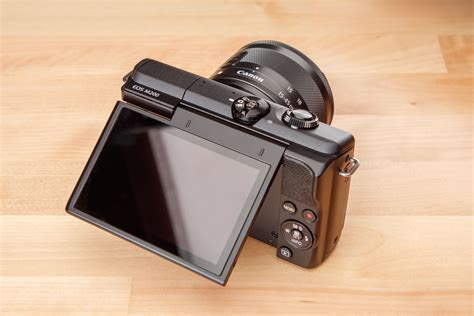
The Eos M200 is characterized by its minimalist design. It lacks the deep handgrip found on larger DSLR or R-series cameras, opting instead for a textured surface that provides just enough friction for a steady hold. The top plate is clean, featuring only the shutter button surrounded by a dial, a movie record button, and a power switch that cycles between photo, auto, and video modes. This reduction in physical dials is a deliberate choice, shifting much of the control to the 3.0-inch tilting touchscreen.
Build quality is impressively solid despite the heavy use of high-quality plastics. It feels dense and well-assembled, lacking the creaks often associated with entry-level electronics. One of the standout physical features is the 180-degree upward-tilting screen. This design is specifically tailored for vloggers and selfie-enthusiasts, allowing the user to see themselves while framing a shot from the front of the lens. The hinge feels robust, maintaining its position at various angles without slipping. While it lacks an electronic viewfinder (EVF), the high-resolution screen is bright enough to remain legible in most outdoor conditions, though direct midday sun can still pose a challenge.
Internal Specifications and Sensor Performance
Under the hood, the Eos M200 houses a 24.1-megapixel APS-C CMOS sensor paired with the Digic 8 image processor. This combination is a significant step up from previous iterations, enabling faster autofocus and improved video capabilities. The APS-C sensor is roughly ten times larger than the sensors found in most high-end smartphones, which translates directly to better low-light performance and a more natural shallow depth of field (or "bokeh") when using wide-aperture lenses.
Initial test shots reveal the "color science" that many photographers praise in this ecosystem. Skin tones appear natural, and the auto-white balance handles mixed lighting conditions with a high degree of accuracy. The ISO range extends from 100 to 25600, and while noise becomes visible at the higher end, images remain surprisingly clean up to ISO 3200. For the casual user sharing on social media, the image quality is a massive upgrade over mobile photography, particularly in terms of dynamic range—the ability to keep detail in both the bright sky and the dark shadows of a landscape.
Autofocus and Tracking
Perhaps the most critical feature for modern creators is the Dual Pixel CMOS AF. This technology allows the camera to focus quickly and smoothly, mimicking the way the human eye finds a subject. In practice, the Eos M200 is snappy. The addition of Eye Detection AF is a game-changer for portraiture and vlogging; the camera identifies the subject's eye and locks onto it, ensuring that even if the person moves slightly, the focus remains sharp. This takes the guesswork out of photography for beginners, allowing them to focus on composition and lighting rather than technical focus points.
Video Capabilities for the Modern Content Creator
The Eos M200 is marketed heavily toward the "social media generation," and its video features reflect this. It supports 4K video recording at 24p, which provides a cinematic look for travel vlogs and short films. However, there is a significant crop factor when shooting in 4K, meaning the field of view becomes narrower. For wider shots in 4K, users may need to step back further or use a wider lens. In contrast, the 1080p Full HD recording uses the full width of the sensor and benefits from the excellent Dual Pixel AF, making it the preferred mode for many everyday clips.
Looking for the best Electronics deals on Amazon?
Shop Amazon →A unique feature of this camera is the "Vertical Video" support. When you record a video with the camera held vertically, it embeds metadata that tells your smartphone or computer to play it back in portrait mode. This eliminates the need to rotate clips in post-production before uploading to platforms like Instagram or TikTok. Additionally, the camera includes a 4K time-lapse mode and the ability to grab high-resolution stills from video footage, providing versatility for those who want to capture a moment in multiple formats simultaneously.
Pros and Cons
After several hours of hands-on time, certain strengths and weaknesses become apparent. This is a camera built for a specific purpose, and understanding those trade-offs is essential for any potential buyer.
- Pro: Portability - The lightweight body makes it an ideal companion for travel and daily carry, fitting into small bags where larger cameras would be left behind.
- Pro: User Interface - The "Guided UI" provides visual explanations of how different settings (like aperture and shutter speed) affect the final image, making it an excellent learning tool.
- Pro: Dual Pixel AF - Fast, reliable, and smooth autofocus that competes with much more expensive professional models.
- Pro: Vertical Video Support - A forward-thinking feature that simplifies the workflow for social media creators.
- Pro: Connectivity - Built-in Wi-Fi and Bluetooth allow for seamless image transfer to a smartphone even when the camera is powered off.
- Con: 4K Crop - The significant narrowing of the frame in 4K mode can be frustrating for indoor or wide-angle videography.
- Con: No Microphone Jack - The lack of a 3.5mm input means users are reliant on the internal stereo mics or must record audio externally and sync in post.
- Con: Battery Life - Like most small mirrorless cameras, the battery is rated for about 315 shots, which may require a spare for a full day of shooting.
- Con: Limited Physical Controls - Advanced users may find the reliance on the touchscreen for settings changes slower than having dedicated physical buttons.
Comparison with Market Competitors
To understand the value proposition of the Eos M200, it is helpful to compare it against its closest rivals in the entry-level mirrorless and high-end compact categories. The following table highlights the key specifications that buyers typically weigh when making a decision.
| Feature | Eos M200 | Typical 1-Inch Compact | Mid-Rang…
For the Aspiring PhotographerIf your goal is to learn the fundamentals of photography—understanding how light works, how to manipulate depth of field, and how different focal lengths affect a scene—the M200 is a fantastic entry point. The Guided UI is like having a photography tutor built into the device. Unlike a smartphone that uses "Computational Photography" to fake background blur, the M200 uses actual optics, allowing you to see the real-world effects of your settings in real-time. For the Vlogger and Content CreatorThe 180-degree screen and the Eye Detection AF are the primary draws for this group. Being able to see your framing while speaking to the camera is essential. However, the lack of an external microphone input is a notable hurdle. If you are a vlogger who needs professional-grade audio, you will need to invest in a separate digital recorder or look for a model higher up in the range. For those making quick clips for social media where ambient audio is acceptable, the M200 is sufficient and highly portable. For the TravelerTravelers often face a dilemma: carry a heavy camera for better photos or stick to a phone for convenience. The Eos M200 is the middle ground. It is light enough to hang around your neck all day without strain, and with the 22mm f/2 pancake lens (sold separately), it can literally slide into a jacket pocket. The ability to transfer photos to your phone via Bluetooth while the camera is in your bag means you can post high-quality travel photos to your stories almost instantly. Lens Ecosystem ConsiderationsOne of the biggest advantages of an interchangeable lens camera is the ability to grow. The EF-M mount has several "native" lenses that are specifically designed to be as compact as the M200 body. Significant options include the 11-22mm for wide landscapes and architecture, and the 32mm f/1.4 for stunning low-light performance and portraits. Furthermore, with an optional adapter, you can use any of the hundreds of EF and EF-S lenses produced for DSLRs, giving you access to nearly any focal length imaginable. Discover deals on Electronics — updated daily. Shop Amazon →The Software Experience and ConnectivityIn the modern age, a camera is only as good as its ability to communicate with other devices. The Eos M200 utilizes a dedicated mobile app that is widely regarded as one of the most stable in the industry. The initial pairing via Bluetooth is simple, and once established, the camera and phone maintain a low-energy connection. This allows you to use your phone as a remote shutter—useful for group photos where you want to be in the frame—and to automatically sync images as you take them. Internally, the camera offers various Creative Filters such as Grainy B/W, Soft Focus, Fish-eye effect, Water Painting effect, Toy Camera effect, and Miniature effect. While many enthusiasts prefer to edit on a computer, having these creative options in-camera allows for immediate stylistic expression. There is also an "Assistant" mode that lets you adjust things like "Background Blur" or "Brightness" through simple sliders on the screen, translating complex photography terms into easy-to-understand visual goals. Real-World Use CasesTo truly understand the Eos M200, we must look at how it performs in everyday scenarios. Imagine taking this camera to a family gathering indoors. A smartphone might struggle with the dim lighting, resulting in grainy, "muddy" images. The M200, with its larger sensor, captures more light, resulting in cleaner files with more detail in the shadows. When the kids start running around, the Dual Pixel AF tracks them across the frame, ensuring their faces remain in focus—a task that often foils simpler cameras. Consider a street photographer walking through a crowded market. The M200 is inconspicuous; it doesn't shout "professional photographer" in a way that might make people uncomfortable. The silent shutter mode allows for discreet candid shots. The ability to tilt the screen also means you can shoot from the hip, looking down at the screen rather than holding the camera up to your eye, which provides a unique perspective and helps capture more natural moments. ConclusionThe Eos M200 represents a bridge between two worlds. It takes the simplicity and connectivity of the smartphone and marries it with the optical power and versatility of an interchangeable lens system. It is not designed to replace a professional's primary workhorse, but it isn't meant to be. Instead, it is a tool for those who have outgrown the limitations of their phone and want a dedicated device that can capture their life with more clarity, more color, and more creative control. While the 4K crop and the lack of a microphone jack might be dealbreakers for some high-end videographers, the target audience—social media creators, families, and travelers—will find a lot to love here. The combination of the 24.1MP sensor, the stellar Dual Pixel AF, and the ultra-portable design makes it one of the most approachable mirrorless cameras on the market today. It simplifies the technical aspects of photography so that the user can focus on what matters most: the story they are trying to tell. Whether you are stepping up from a phone for the first time or looking for a secondary camera that won't weigh you down, the Eos M200 proves that great things can indeed come in small packages. Browse Electronics Deals and SaveCompare top products and pick the one that's right for you. Browse Deals →
We are a participant in the Amazon Services LLC Associates Program, an affiliate advertising program designed to provide a means for us to earn fees by linking to Amazon.ca and affiliated sites.
|
|---|